

The Client
It’s easy not to think about insurance until you need it. And once you need it, it’s all you can think about. Even if you don’t know it, there is a rainbow of different types of coverage, which is the specialty of our client. They are a health insurance company that focuses on providing specialized types of insurance coverage for specific groups and needs. Within all of its different types of coverage, its student health insurance division is by far its biggest. The student health team manages coverage for college students nationwide, balancing relationships with brokers, school administrators, and institutional buyers. Broker relationships account for more than ninety percent of revenue, so conference attendance, follow-up, and account maintenance are critical to what they do. Direct business comes from schools that purchase coverage directly through their website or from existing relationships, and that can be a lot to keep track of.
With a team of hundreds of employees and numerous business units to match, the company’s marketing and sales functions had drifted slowly apart. Their marketing department was taking charge of lead generation and awareness across product lines, while the sales team focused on renewals and broker management. Although their Salesforce administrator worked tirelessly to keep the data clean, the mutable processes of both marketing and sales made this increasingly more difficult. Everyone sensed the same issue: work was happening, but no one could see the full picture.
The Challenge
Marketing and sales operated in parallel, but each with their own systems, definitions, and metrics. To complicate the matter further, their contact records were moving between tools without context. The marketing team didn’t know what sales did with them, and sales couldn’t tell how those leads had engaged before reaching out to them. On top of this, their contradicting reports didn’t help make sense of anything. The sales team was struggling with inconsistent processes and lacked clear documentation to guide new members. The company was using Salesforce and HubSpot as their core sales and marketing systems, and even though the whole company knew HubSpot could do more for them, no one knew where to start or how to use it beyond email sends and form submissions.
One of the clearest signs of misalignment showed up when it came time to judge their lead quality. The student health website was swamped with constant form submissions from students, even though the company sells only to school administrators and brokers. Each irrelevant submission took time to triage and distracted the team from qualified opportunities. The leads coming in from the website artificially inflated their reporting, which sales team members were managing on an individual basis. The sales reps were managing their own lists and dashboards, building reports from scratch, and updating records by hand. For a business that relies on relationships, too much of its team's time was being wasted on administrative tasks. They knew, and wanted to do better. That’s when they got in touch with ClearPivot.
The Solution
ClearPivot began by pinning down the famously fluid processes. They kicked off the project by mapping the full customer lifecycle in Lucidchart. Every handoff, duplicate step, and delay was charted to expose the points where work slowed or visibility dropped. We started with the marketing team, and once the current state was clear, the sales team joined to define the ideal flow. Together, they outlined what data needed to move, when it should move, and who should own each stage. The result became both a process reference and a blueprint for system design.
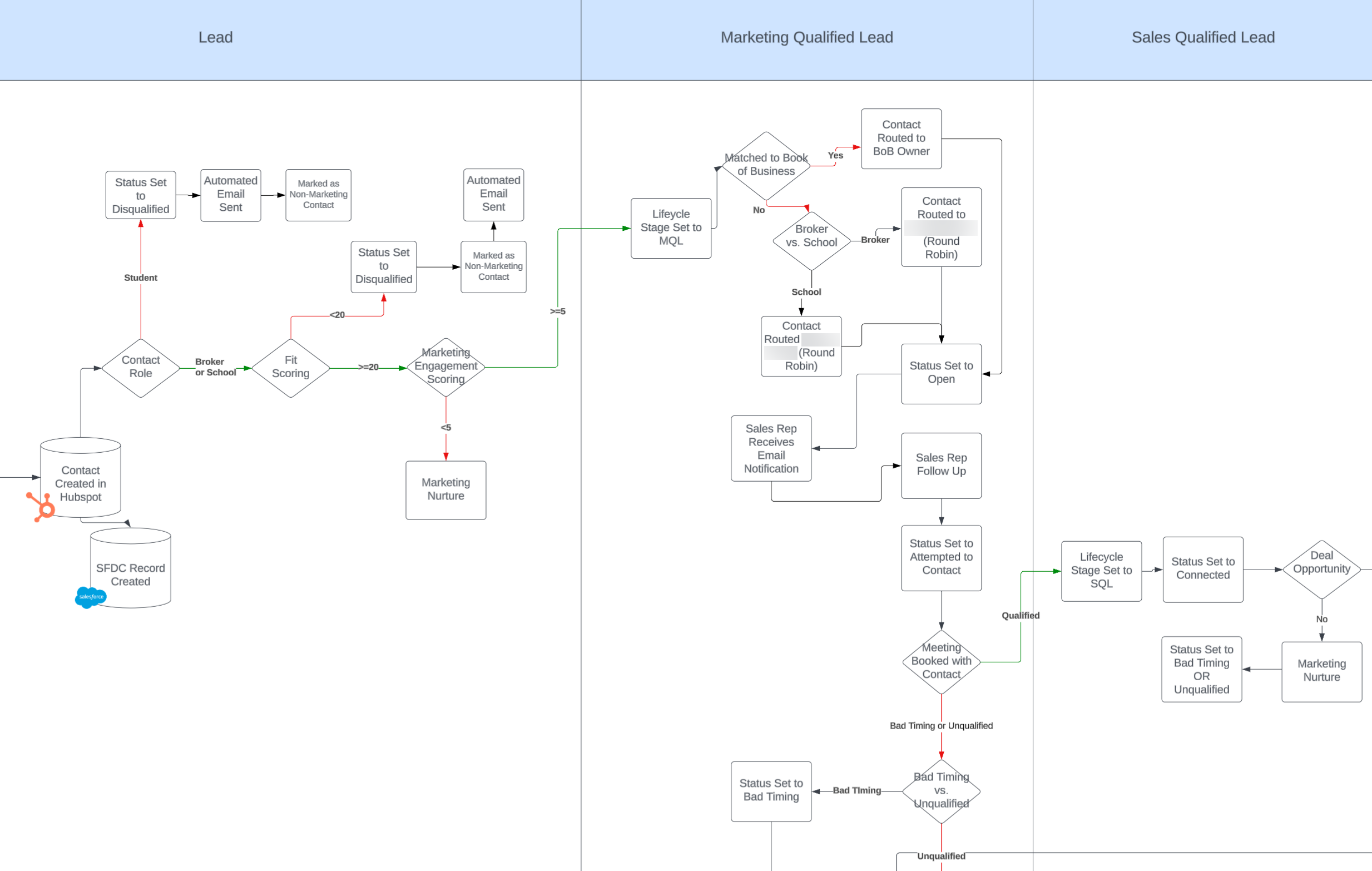
The next step was to make sure the right people were sending submissions to their website forms. ClearPivot quickly solved the problem by adding a new “role” field to all lead forms so students could identify themselves. When someone selected “student” on the form, it now triggered an automated email that directed them to contact their school administrator instead of entering the sales process. The record was disqualified automatically, keeping the pipeline clean and preventing wasted time.
Next step? Contact routing. The ClearPivot team redesigned the company’s contact routing around account ownership, so leads flowed directly to the right representative with consistent naming and property values. Then, corresponding opportunities were automatically created in Salesforce without manual entry. For the Special Risk division, ClearPivot implemented a dedicated quote form integrated with HubSpot and Salesforce, complete with UTM tracking, data validation, and automatic report generation. Requests got routed directly to the right team, and opportunities appeared instantly in Salesforce dashboards.
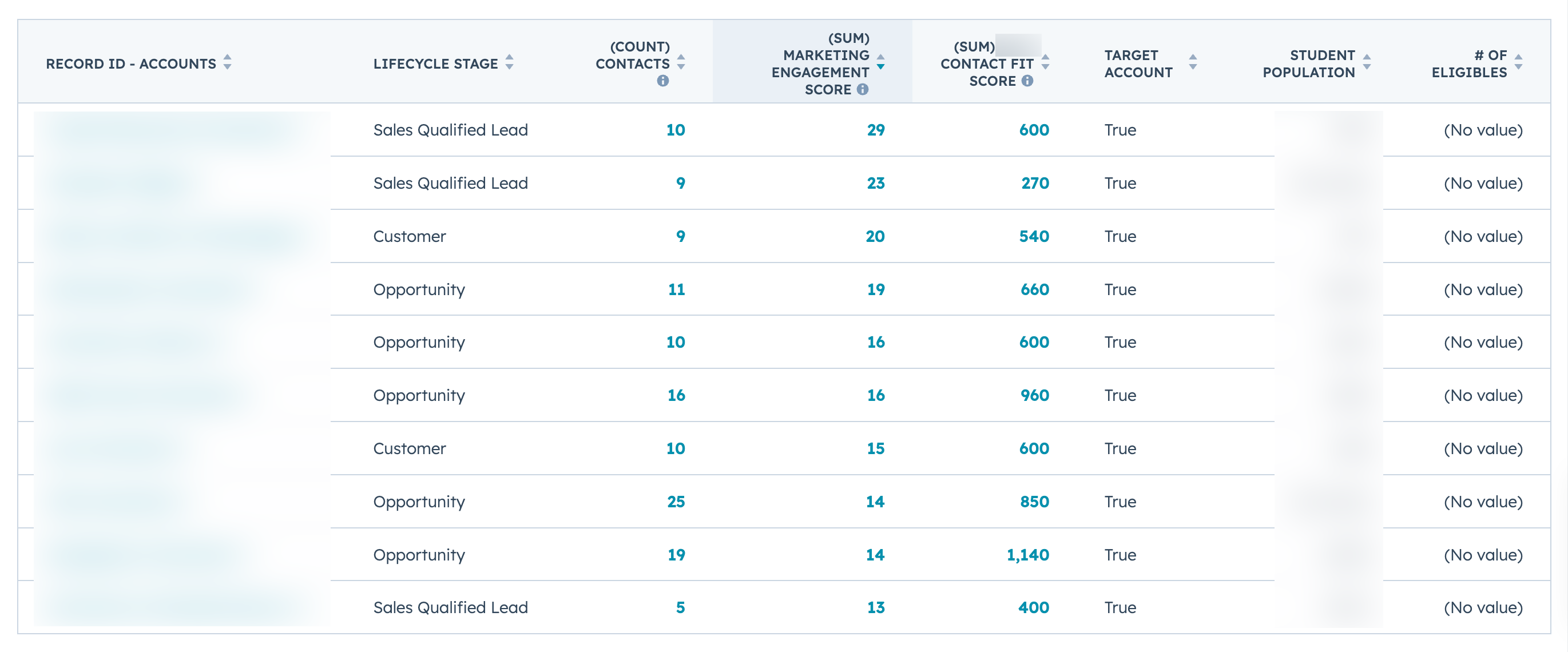
The last piece was creating the dashboards and documentation that tied everything together. For the marketing team, ClearPivot prepared funnel, sequence, and channel performance views. The sales team also got a tailored dashboard, this time focusing on account engagement, contact activity, and open opportunities. The biggest difference was the robust documentation so the team could keep up with future changes. This documentation kept all lifecycle stage definitions, routing logic, scoring models, and data flow diagrams stored for reference. Lastly, to ensure the team could confidently make sense of and update the reports, ClearPivot provided training on the inner workings of the dashboards.
.png?width=716&height=431&name=Screenshot%202025-12-15%20at%205.29.04%20PM%20(1).png)
The Results
The company got clarity in every sense of the word. The lifecycle map became a shared reference guide for marketing, sales, and operations, replacing haphazard processes and data with a single model that everyone understood. Lead quality rose immediately once contact roles and fit scores went live, meaning that they were pulling from better and more complete data. On top of all that, unqualified student inquiries no longer reached sales, which finally gave the team the time they needed to focus on actual qualified accounts.
Sales team members' response times were shortened almost instantly because routing and scoring worked in real-time. Instead of doing everything manually, opportunities were created automatically, and their dashboards were updated accordingly. Team members followed up more quickly, and marketing could finally see which campaigns generated revenue. The marketing leader described it best: “We’ve never had this much engagement from the sales team.”
All of this work wasn’t only done thinking of the present. Future hires can now join the team with documentation that shows them how things really work, ensuring they have the resources to understand the system from day one. The silos between marketing and sales were finally gone.
Ultimately, ClearPivot provided this team with a living operational framework. Now, they can trust in their processes to give top-tier service to the prospects that need it.
